
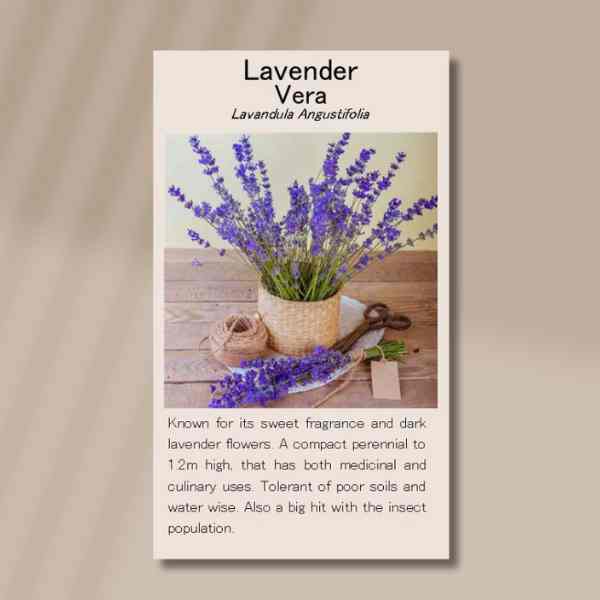



Lavender Vera
$4.95
Lavandula Angustifolia
- Seed Count 200
- Drought Tolerant
- Height 120 cm
- Perennial
In stock
Description
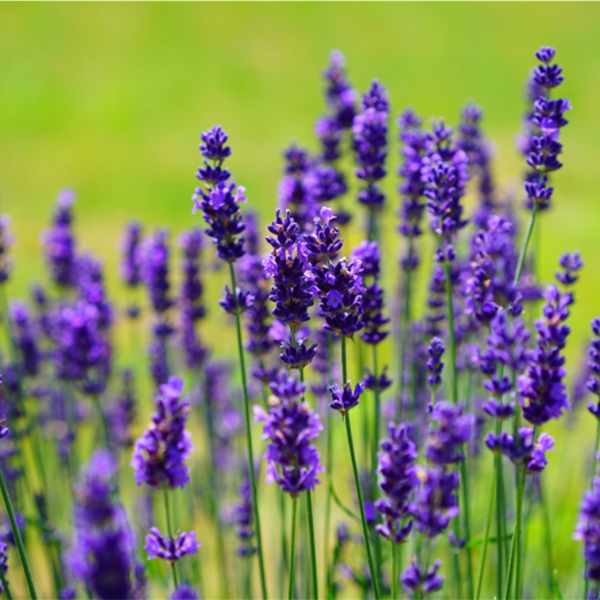
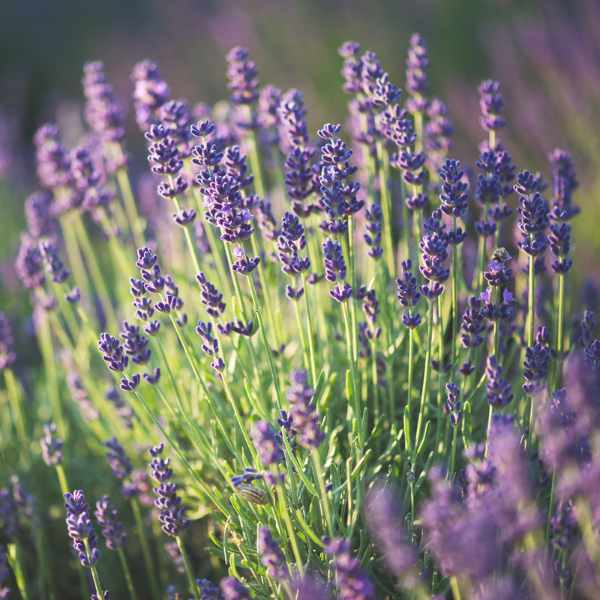
Lavender Vera has long been valued for its sweet fragrance and deep, dark lavender-coloured flowers. This is a compact perennial that has proven itself as both tough and versatile, thriving even in poor soils and standing strong in dry conditions where fussier plants might give up.
It is a no-nonsense worker, blooming freely and generously over a long season, making it a reliable favourite not just for gardeners but for beneficial insects too. Bees, butterflies and other pollinators are irresistibly drawn to its nectar-rich flowers, and once it is in bloom you will notice the hum of garden life intensify around it.
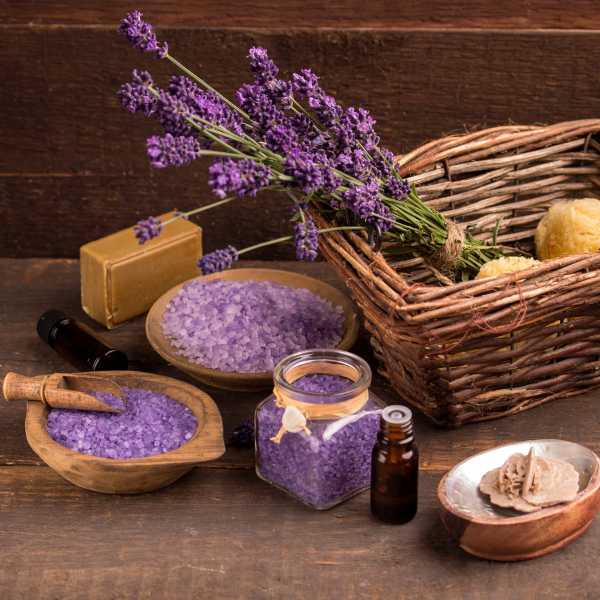
Beyond its role in the garden, it is one of those plants that sits comfortably between the ornamental border, the kitchen, and the medicine cabinet, offering a kind of three-in-one value that few others can match. Herbalists have long turned to lavender for its calming properties, and the flowers are commonly used in remedies for headaches, mild depression, and insomnia. Many households tuck dried lavender into sachets and place them near pillows or in linen cupboards to encourage sleep and keep bedding fresh.
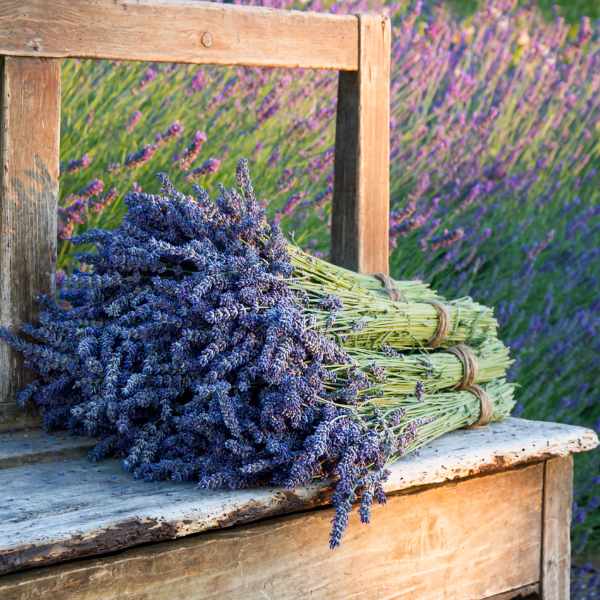
Its sweet and lingering scent, makes it a popular choice in homemade perfumes, soaps, and bath products and even without going to the effort of creating oils or perfumes, simply drying a bunch of Lavender Vera and placing it in a vase will lift the mood of a home and brings a sense of calm.
While lavender might not be the first herb people think of for the kitchen, it has a long tradition of use in both sweet and savoury recipes. The flowers can be infused into soft drinks, adding a subtle floral note that is both refreshing and unique. Bakers often fold lavender into biscuits, shortbread, and cakes, where its delicate flavour complements sugar and butter beautifully. On warm days, the flowers can be used to flavour sorbets or ice creams, creating desserts with a light, perfumed taste that feels just right for summer. Even a small amount goes a long way, lending a sophisticated edge to ordinary recipes. Those who enjoy experimenting in the kitchen will find Lavender Vera a treasure, an ingredient that turns everyday cooking into something memorable.
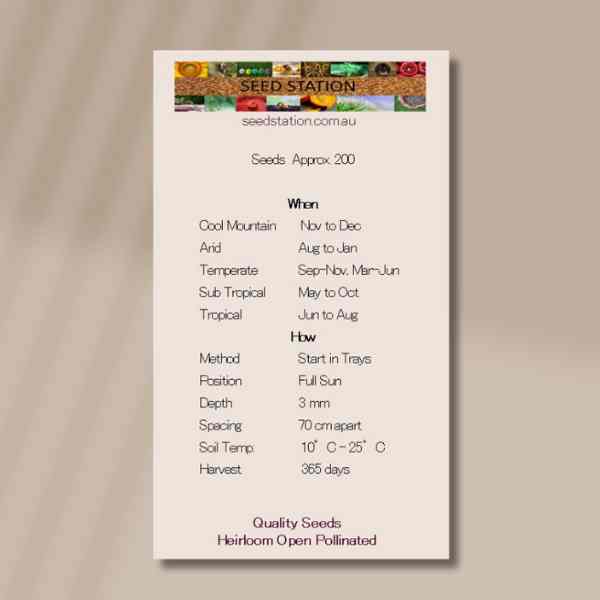
| Method: Raise seedlings | Soil Temp: 10°C - 25°C |
| Cool Mountain: Nov - Dec | Germination: 14 - 21 Days |
| Arid: Aug - Jan | Position: Full sun |
| Temperate: Sep-Nov, Mar-Jun | Row Spacing: 1m apart |
| Sub Tropical: May - Oct | Planting Depth: 3 mm |
| Tropical: Jun - Aug | Harvest: 365 days |
❄️ Seed pre-treatment
Lavender seed can be slow to germinate and has a variable germination rate. A little pre-treatment helps.
- Optional soak. Soak seeds 12 to 24 hours in room-temperature water to help soften outer seed coat. Do not soak longer or seeds may rot.
- Cold stratification. Place soaked seeds between damp paper towel or in a small bag of moist vermiculite, then refrigerate for 2 to 4 weeks. This mimics winter and improves germination for many English-type lavenders.
- No scarification needed. You do not need to nick seeds.
- Some seeds will germinate without treatment but expect slower or patchier results.
If you want a simpler route, skip pre-treatment and sow anyway. You may just have to be patient.
🌱 Sowing: trays vs direct sowing
There are two routes: start in trays and transplant, or sow directly where you want the plants. Both work. Here’s how to decide and how to do each.
Sowing in trays
Starting lavender in trays or pots gives you more control, better germination monitoring and reduces losses to birds, slugs and competition. It is the preferred method for small seeds like lavender.
Method
- Use a shallow seed tray or small pots and a free-draining seed mix. Mix 60 to 70 percent fine seed-raising mix with 30 to 40 percent coarse sand, perlite or grit. Lavender needs excellent drainage even as a seedling.
- Fill trays, firm lightly and water from below so the mix wets evenly without disturbing seeds.
- Sow seeds on the surface. Do not bury more than 1 to 2 mm. Lavender seed needs light or very shallow covering to germinate. Sprinkle a fine film of vermiculite if you like.
- Keep humidity moderate using a clear lid or plastic wrap, but allow some air exchange to avoid fungal problems.
- Ideal germination temperature is about 15 to 22°C. Cooler climates may be slower. Bottom heat helps but is not essential.
- Keep mix barely moist. Overwatering causes damping off.
- Germination can take 2 to 4 weeks or longer. Resist the urge to overwater.
- When seedlings have a couple of true leaves and are sturdy enough, prick them out into small tubes or 7 to 10 cm pots into the same free-draining mix. Harden off for 1 to 2 weeks before planting out.
Pros of trays
- Better germination rates and protection.
- Easier to control moisture and temperature.
- Reduced competition and pests initially.
- Allows selection of the strongest plants.
Cons of trays
- Requires extra step of transplanting.
- Needs bench space and some attention.
Direct sowing
Direct sowing is simpler and suits warm, well-draining sites. It can work very well in Mediterranean-style beds or dry slopes.
Method
- Choose a sunny, well-drained spot and prepare the soil by digging in coarse grit and sharp sand to ensure drainage. Remove perennial weeds.
- Sow seeds on the surface in late winter to early spring in cool temperate areas, or in autumn in warmer parts of Australia. Lightly press seeds into soil or cover with a fine layer of grit or vermiculite.
- Keep soil just moist until germination. Mulch lightly with coarse grit around seedlings later to keep weeds down but not over the crown.
- Thin to final spacing once seedlings are established.
Pros of direct sowing
- Low fuss and suits dry, established beds.
- No transplant shock if site and conditions are ideal.
Cons of direct sowing
- Poorer germination in heavy soils or under competition.
- More losses to birds, slugs, and weeds.
- Slower establishment in marginal spots.
My tip: If you are new to seeds, start some in trays and also try a few direct-sown spots. You get the security of transplants and the low-effort option of direct sowing.
🌍 Soil and position
- Sunlight. Full sun. Aim for 6 hours or more of direct sun daily. Lavender in shade becomes leggy and flowers poorly.
- Soil texture. Very free draining. Sandy loam or gravelly soil is best. If your soil is heavy clay, raise beds or add lots of coarse sand, grit and organic matter plus gravel to create drainage. Planting on a mound helps.
- pH. Neutral to alkaline is preferred. Aim for pH 6.5 to 8. Slightly alkaline soils suit lavender, but many types manage on neutral soils.
- Organic matter. Keep organic matter moderate. Lavender hates rich, nitrogen-laden soils that produce soft, floppy growth. Add a handful of compost but avoid heavy manuring.
- Mulch. Use coarse gravel or small stones around the base for moisture control and to keep crowns dry. Avoid thick organic mulches that retain moisture.
📏 Planting and spacing
- Spacing. English lavenders 30 to 50 cm apart depending on variety. Larger hybrids 60 to 90 cm apart. Check variety habit.
- Planting depth. Plant at the same depth as in the pot. Do not bury the crown. Plant on a slight mound in heavy soils.
- Water in well after planting and then water sparingly until established.
💧 Care and maintenance
Watering
- Seedlings need regular moisture until established. Water moderately and allow surface to dry between waterings.
- Once established lavender is drought tolerant. Too much water is one of the main causes of failure. Water deeply but infrequently in dry spells. Reduce watering in humid regions.
Feeding
- Minimal feeding. A light top dressing of well-rotted compost or low phosphorus slow-release fertilizer in spring is enough.
- Avoid high nitrogen feeds. Excess fertility causes soft growth and fewer flowers.
Pruning
- Prune annually to keep shape and encourage flowering. For spring-flowering types prune after flowering or late winter depending on the cultivar.
- Cut back about one third of the growth into firm young wood. Avoid cutting into old, woody stems with no green growth. If you leave plants too long unpruned they become woody and difficult to renew.
- A formative prune in the first two years helps a compact shape.
Mulching and winter
- In cold or wet regions provide good winter drainage and protect crowns from waterlogging.
- In mild regions coarse gravel mulch helps retain a dry root environment.
Pest control
- Generally low pest pressure. Watch for aphids, spittlebugs and caterpillars. Cultural controls first, then insecticidal soap or neem if needed.
Flowering
- Deadhead spent stems to encourage further blooms. For cut flowers harvest at the tight bud stage for best colour and oil.
🌿Companion planting guide
Lavender prefers companions that like the same dry, sunny, low-nutrient conditions.
Good companions
- Rosemary and sage. Similar water and sun needs.
- Thyme and oregano. Low-growing herbs that tuck in nicely.
- Catmint (Nepeta). Long flowering and complementary habit.
- Echinacea and Rudbeckia. Pollinator-friendly, bold perennials that pair well.
- Ornamental grasses like Festuca and Pennisetum. Offer texture and good drainage partnership.
- Lavender also works well near hot, sunny rockeries, Mediterranean beds and dry borders.
Avoid
- Heavy feeders and moisture lovers like brassicas, corn, leeks or lettuce close by. They prefer richer, wetter soil and will not be happy next to lavender.
- Large trees that create shade and root competition.
Design tip
- Use lavender as a spine or edge planting and mix with low herbs and gravel to create a Mediterranean feel.
✂️ Harvesting and drying
- Best time to harvest. Cut stems when the first few flowers on the spike have opened but most are still in bud. That is when scent and oil content are at their best.
- Time of day. Harvest mid-morning after the dew has dried for best oil retention.
- How to cut. Cut stems long, remove lower leaves and gather into small bundles. Tie loosely. Avoid cutting into very woody stems; aim for a few cm of green growth.
- Drying. Hang bundles upside down in a cool, dark, well-ventilated spot. Alternatively lay out on racks. Drying commonly takes 7 to 14 days.
- Storage. Once dry, store in airtight containers away from light for potpourri or sachets. For essential oil extraction follow steam distillation methods and safety protocols.
🐞 Common issues and fixes
| Problem | Signs | Likely cause | Fix |
|---|---|---|---|
| Poor germination | Few or no seedlings after 4 weeks | Old seeds, no stratification, overwatering, too deep sowing | Use fresh seed, pre-treat (soak + cold stratify), sow on surface, keep mix just moist, try trays with good drainage |
| Damping-off | Seedlings collapse at soil line, white mold sometimes present | Overly wet conditions, poor air flow | Improve drainage, reduce humidity, use clean seed mix, avoid overwatering, remove affected seedlings |
| Root rot | Yellowing, wilting, soft roots | Waterlogged soil or heavy clay | Replant into free-draining mix, raise bed, improve drainage with grit, avoid overwatering |
| Leggy, floppy plants | Tall, stretched stems, few flowers | Too much shade or too much nitrogen | Move to sunnier spot, reduce fertilizer, prune to encourage compact growth |
| Few flowers | Sparse blooms despite foliage | Too much shade, too rich soil, overwatering, improper pruning | Ensure full sun, reduce fertility, cut back to shape after flowering, improve drainage |
| Woody, bare-centred plants | Old woody stems with few leaves | Not pruned regularly, natural aging | Prune annually into young wood; where too woody consider replacing or severe rejuvenation cut if some green growth remains |
| Aphids or scale | Sticky residue, curled leaves or small insects on new shoots | Sap-sucking pests | Blast with water, use insecticidal soap or neem oil, encourage predators like ladybirds |
| Fungal leaf spots or botrytis | Brown spots, grey mold in humid conditions | High humidity, poor airflow, overhead watering | Improve airflow and drainage, remove infected parts, avoid overhead watering, clean up debris |
| Winter dieback | Browning stems at crown | Waterlogged soil during winter, cold plus wet | Improve drainage, plant on a slope or mound, protect crown from constant moisture |
🌾Seed saving guide
- Choose plants. Use healthy, true-to-type plants. If you want consistent cultivar traits, know that seed from hybrids may segregate. For clones, use cuttings instead.
- Let flowers set seed. After flowering leave a few stems on the plant to form seed. The flowers will dry and the seed will mature in the spent flower spikes. Don’t harvest too early. Wait until the flower heads turn pale brown and papery.
- Harvest timing. Cut whole spikes when most of the calyces have browned but before seeds are scattered in wind. A dry day is best.
- Drying. If the seed heads are not fully dry, finish drying them in a warm, airy place out of direct sun for several days.
- Threshing. Once dry, rub or roll the heads between your hands to free the seeds. You can use a sieve to separate chaff from seed. Lavender seed are small; some cultivars produce relatively few seeds per spike but many spikes make up for it.
- Cleaning. Use a fine mesh sieve and gentle airflow (a fan on low) to remove chaff. Be gentle to avoid blowing away seeds. A coffee grinder is not appropriate.
- Storing. Place cleaned seed in paper envelopes or small glass vials. Label with variety and date. Store in a cool, dry, dark place. Refrigeration adds longevity but avoid moisture.
- Viability. Lavender seed viability is typically 2 to 3 years. Germination declines with time so test a small sample before large sowings.
- Record keeping. Note the parent plant, location, and year. This helps if you want to propagate the same traits in future.
- Consider clones for true-to-type. If the variety is a named hybrid and you want exact replication, propagate by cuttings rather than by seed.
🪻 Final thoughts and practical calendar
- Patience. Lavender from seed takes longer to reach flowering size than nursery plants. Expect 1 to 2 years to a well-flowering mound depending on variety and conditions.
- Keep it lean. Lavender thrives on neglect compared with fussy perennials. Good sun, excellent drainage and light feeding are the recipe.
- Renew when needed. Lavender is long lived but not immortal. If a plant becomes very woody and fails to respond to pruning, replace it and use some of the saved seed or take cuttings from the best plants.
- Start small and expand. Try a few plants first and learn the microclimate of your garden. Then add more once you know what your patch likes.
If you want, I can:
3 reviews for Lavender Vera
| 5 star | 100% | |
| 4 star | 0% | |
| 3 star | 0% | |
| 2 star | 0% | |
| 1 star | 0% |

Postage Charge
Orders under $35 attract a $4.95 shipping charge. Orders $35 and above have free shipping.
Order Times
Seed orders are normally dispatched within three business days. You will receive an email when seeds are mailed out.
Postage Days
Seeds are mailed out Tuesday to Friday at 1pm. Except for the Friday of long weekends.
Postage Times
WA 2-3 Days: SA,NT 3-5 Days: NSW, ACT, QLD, VIC: 5-7 Days
Carrier
We use Australia Post Letter Postage for the majority of orders
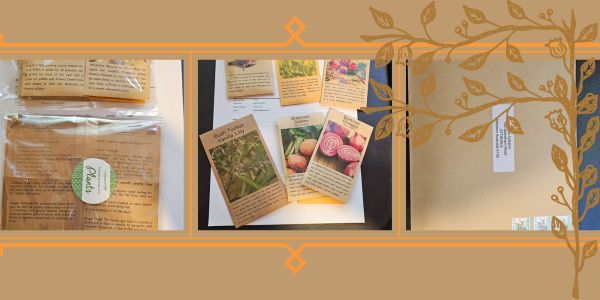
Not only are our seeds packed in recycled paper envelopes, we keep the theme going when we post out website orders. To protect your seeds from moisture and the letter box munchers (snails), we use a very special plastic free material made from plants. They are then put into recycled mailing envelopes. Green all the way 💚🌿
Delivery Guarantee
We take great care to make sure your seeds arrive safely. If your order is lost or damaged in transit, we’ll happily send a replacement. Unfortunately, we can’t replace or refund orders that arrive later than the estimated delivery date, as delays can sometimes occur that are outside our control.
Please note that all dispatch and delivery times listed are estimates only. While we do our best to post promptly, delivery timeframes can vary due to postal service delays, weather events, or other unforeseen circumstances. We’re unable to take responsibility for any loss, damage, or cost that results from a late delivery.
An order is not considered missing until at least 20 business days have passed from the postage date. You’ll receive an email once your seeds have been posted, letting you know they’re on their way. If you don’t see it in your main inbox, please check your Spam or Promotions folders as sometimes our emails like to hide there.
See all our verified customer reviews on our official CusRev profile.
See all our verified customer reviews on our official CusRev profile.
Not planted as yet due to hot weather
See all our verified customer reviews on our official CusRev profile.