



Cabbage Michihili
$4.95
Brassica Pekinensis
- Seed count 100
- Crisp And Refreshing
- Annual
In stock
Description
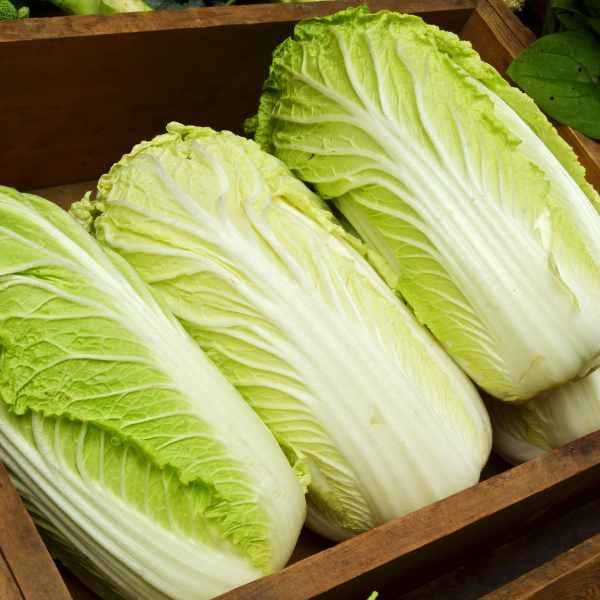
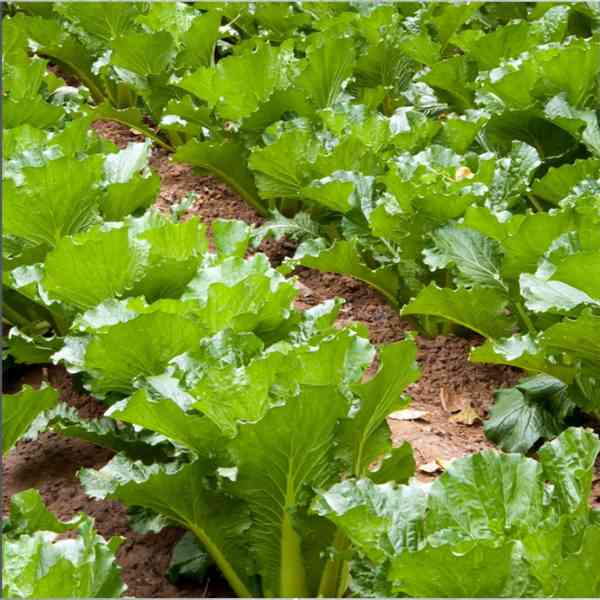
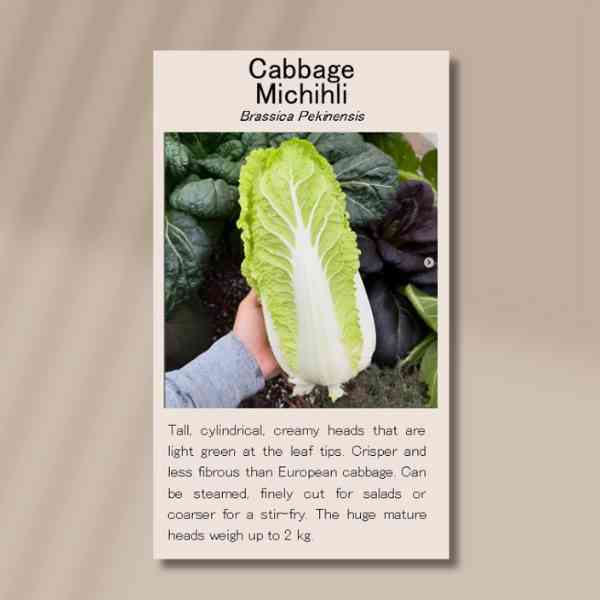
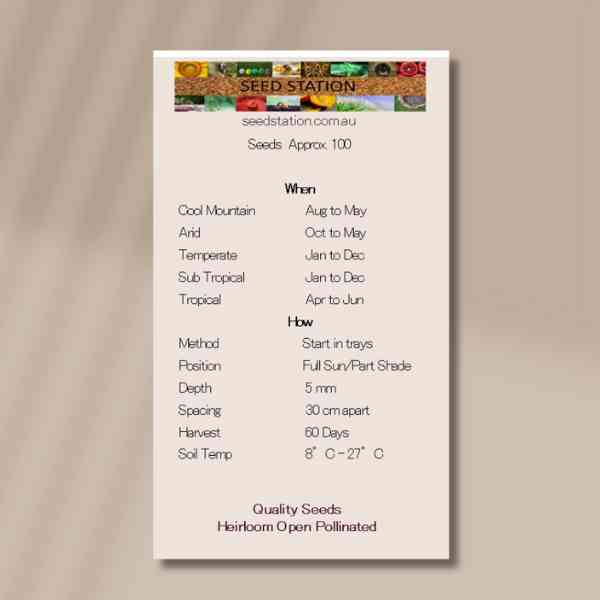
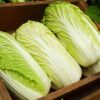
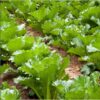
Cabbage Michihili is an heirloom Chinese variety with a long history of use, valued for both its looks and its eating quality. At first glance it does not resemble the round, tightly wrapped European cabbages many of us grew up with. Instead, it forms tall, cylindrical heads that stand upright in the patch, creamy white at the base and shading through pale green to deeper green at the tips, rather like an oversized romaine lettuce.
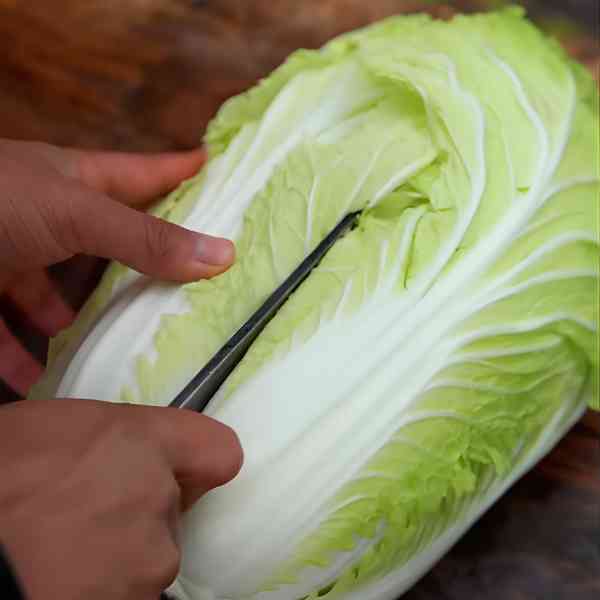
The leaves are a big part of its appeal. They have a crinkled, almost savoy-like texture with white veining is clearly defined, and each leaf carries a prominent white midrib that broadens as it reaches the base, sometimes widening to as much as 10 centimeters. This thick midrib gives the head structure and substance, while the softer green leaf edges remain tender and flexible. When the plant is mature, the cylindrical head is leafy rather than tightly packed, which makes it easy to work with in the kitchen and pleasing to look at when harvested.
The flavour of Chinese cabbages is generally more subtle and pleasant than that of traditional European head cabbages. Michihili is no exception. The leaves are crisp and refreshing, with a clean taste that does not dominate other ingredients. There is less bitterness and far less fibrous texture than you might expect from a large cabbage, especially when compared to older European varieties. This makes it a vegetable that people who think they do not like cabbage often find themselves enjoying.
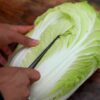
In the kitchen, Michihili is wonderfully adaptable. The tender leaves are often used raw, just as you would use a good romaine lettuce. They work beautifully in salads, where their mild flavour allows dressings and other ingredients to shine. Shredded finely, they make an excellent base for coleslaw, offering crunch without the heaviness that some cabbages bring. The white midrib, while substantial, is not tough, and when sliced thinly it blends well with the softer leaf sections.
When sown in spring, it can be enjoyed young, with tender leaves harvested for salads. In this stage, it behaves much like a romaine lettuce, offering crisp leaves that hold their shape and provide a satisfying crunch. When sown in late summer, it goes on to form full-sized heads for an autumn harvest, with mature cabbages typically weighing up to 2 kilograms. This ability to fit into different seasons and uses is part of what has kept Michihili popular over generations.
| Method: Sow direct | Soil Temp: 10°C - 20°C |
| Cool Mountain: Mar - May | Position: Full sun |
| Arid: Nov - Dec | Row Spacing: 30 cm |
| Temperate: Oct - Nov | Planting Depth: 3 mm |
| Sub Tropical: Aug - Sep | Harvest: 80 Days |
| Tropical: Apr - Aug | Plant Height: 40 cm |
🌱 Sowing from Seed: Trays vs Direct
Cabbage seeds can be started either in trays or direct-sown, though starting in trays tends to give better control, especially in regions with fluctuating weather or slug problems.
Tray Sowing (recommended):
Starting in seed trays or punnets gives you a strong start. You can protect the seedlings from pests, weather, and overcrowding, and transplant them when they’re ready.
- When: In temperate zones, sow late summer through early autumn for an autumn-winter harvest. In cooler regions, you can also sow in spring for a summer crop.
- How: Sow seeds around 5mm deep in a quality seed-raising mix. Keep moist but not soggy.
- Transplant: When they’re 4–6 weeks old and have 4–6 true leaves, transplant into garden beds about 40–60cm apart.
Direct Sowing:
If your climate is mild and your garden’s fairly pest-free, direct sowing can work just fine.
- When: As above, timing depends on your region—aim to avoid the hottest and coldest months.
- How: Sow 2–3 seeds per station, 5mm deep, 40–60cm apart. Thin to the strongest seedling once established.
🧪 Is Seed Pre-treatment Needed?
No pre-treatment is needed for cabbage seeds. They’re fairly quick to germinate (around 5–10 days in warm soil) and don’t require soaking or stratification.
🌞 Soil & Position
Cabbage is a heavy feeder and needs rich, fertile soil to form those big, dense heads.
- Soil Prep: Add compost, aged manure, or a balanced organic fertiliser before planting. A neutral pH (around 6.5–7) is ideal.
- Sunlight: Full sun is essential—6–8 hours a day.
- Drainage: Soil should hold moisture but drain freely. Raised beds work well if you have heavy clay.
In my own garden, I always rotate brassicas (like cabbage) with legumes or root crops to keep the soil healthy and avoid disease buildup.
🌿 Care & Maintenance
Once your cabbages are in the ground, it’s all about consistency.
- Watering: Keep the soil evenly moist, especially as heads start to form. Dry spells can cause splitting.
- Mulching: Mulch around plants to hold moisture and suppress weeds.
- Feeding: Give them a boost with a liquid seaweed or fish emulsion every few weeks.
- Support: Larger varieties might need staking in windy spots.
- Weeding: Keep weeds down—cabbage doesn’t like competition.
🌼 Companion Planting Guide
Cabbage gets along well with quite a few helpful neighbours.
Good Companions:
- Onions, leeks, garlic – help repel aphids and cabbage moths.
- Chamomile and dill – attract beneficial insects.
- Celery and beets – grow well alongside without competing heavily.
Avoid planting near:
- Strawberries and tomatoes – these can stunt cabbage growth.
- Other brassicas (e.g. broccoli, kale, cauliflower) – too many in one space can attract pests and deplete the same nutrients.
✂️ Harvesting
Cabbage is ready to harvest when the head feels firm and solid when gently squeezed.
- Timing: Depending on the variety, this can be 10–14 weeks from transplanting.
- Method: Use a sharp knife to cut the head at the base. Leave the outer leaves and root in place—you might get some mini side shoots!
- Storage: Heads can be stored in the fridge for a few weeks, or kept in a cool, dark pantry. Don’t wash until you’re ready to use them.
🐛 Common Issues & Fixes
| Issue | Cause | Fix |
|---|---|---|
| Cabbage moths (white butterflies) | Caterpillars eating leaves | Use fine mesh netting, check for eggs, hand-pick caterpillars |
| Aphids | Sap-sucking pests | Blast with water, use insecticidal soap, encourage ladybirds |
| Cabbage thrip | Tiny insects that cause silvering of leaves | Use neem oil or pyrethrum, rotate crops, remove plant debris |
| Splitting heads | Irregular watering or heavy rain | Maintain even watering, mulch to reduce stress |
| Clubroot | Soil-borne fungus | Practice crop rotation, raise soil pH with lime, don’t plant brassicas in the same spot annually |
🌼 Seed Saving Guide
Saving seed from cabbage takes a bit of patience, but it’s a rewarding way to close the loop in your garden.
What You Need to Know:
- Cabbage is biennial, meaning it sets seed in its second year.
- It’s insect-pollinated and cross-pollinates easily with other brassicas, so only grow one variety to save pure seed, or isolate by distance (1km minimum).
Steps:
- Select healthy, true-to-type plants and let them overwinter.
- In spring, they’ll send up tall flower stalks.
- Allow flowers to form and be pollinated.
- When the seed pods turn brown and dry, cut the stalks and place in a paper bag.
- Dry thoroughly indoors, then crush pods gently to release seeds.
- Store in an airtight container in a cool, dry place—label with the year!
Viability: Cabbage seeds last 4–5 years if stored well.
🌻 Final Thoughts
Cabbage is a classic cool-season crop in Australia and one of the most satisfying to grow from seed. While it does need a bit of space and attention, the rewards—those dense, crisp heads—make it all worthwhile. Like most brassicas, it thrives in a garden that’s planned with rotation and variety in mind. Don’t be discouraged by a few pest nibbles—it’s all part of the learning!
If you’re new to growing from seed, start with a reliable heirloom variety, give it some TLC, and enjoy the process. You’ll get better with every season 🌱
Happy growing!
2 reviews for Cabbage Michihili
| 5 star | 100% | |
| 4 star | 0% | |
| 3 star | 0% | |
| 2 star | 0% | |
| 1 star | 0% |
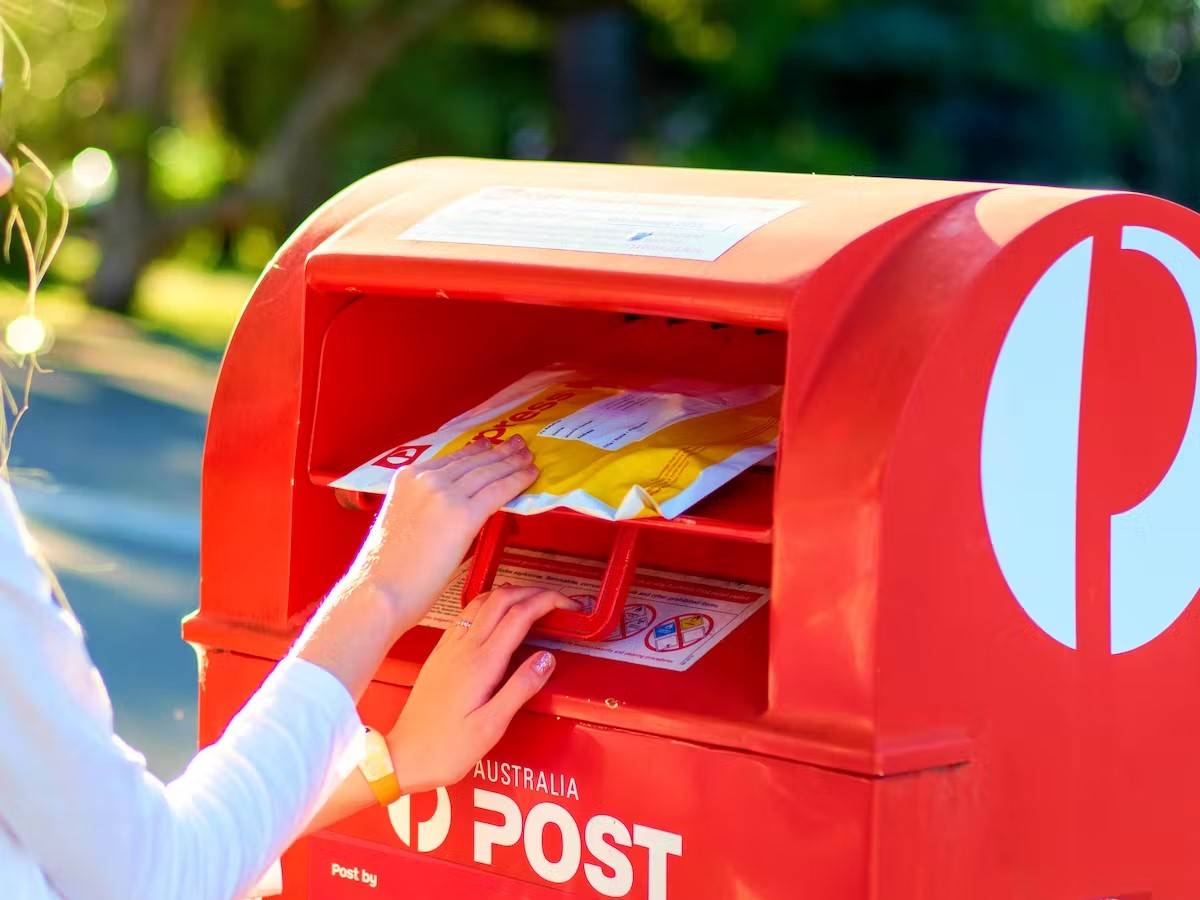
Postage Charge
Orders under $35 attract a $4.95 shipping charge. Orders $35 and above have free shipping.
Order Times
Seed orders are normally dispatched within three business days. You will receive an email when seeds are mailed out.
Postage Days
Seeds are mailed out Tuesday to Friday at 1pm. Except for the Friday of long weekends.
Postage Times
WA 2-3 Days: SA,NT 3-5 Days: NSW, ACT, QLD, VIC: 5-7 Days
Carrier
We use Australia Post Letter Postage for the majority of orders
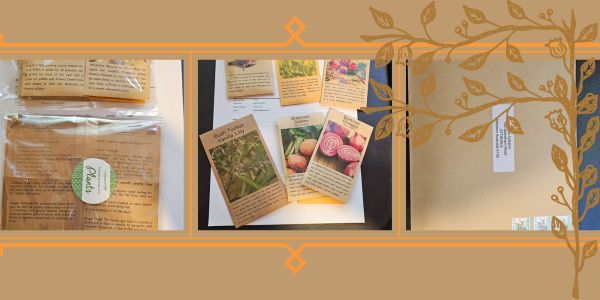
Not only are our seeds packed in recycled paper envelopes, we keep the theme going when we post out website orders. To protect your seeds from moisture and the letter box munchers (snails), we use a very special plastic free material made from plants. They are then put into recycled mailing envelopes. Green all the way 💚🌿
Delivery Guarantee
We take great care to make sure your seeds arrive safely. If your order is lost or damaged in transit, we’ll happily send a replacement. Unfortunately, we can’t replace or refund orders that arrive later than the estimated delivery date, as delays can sometimes occur that are outside our control.
Please note that all dispatch and delivery times listed are estimates only. While we do our best to post promptly, delivery timeframes can vary due to postal service delays, weather events, or other unforeseen circumstances. We’re unable to take responsibility for any loss, damage, or cost that results from a late delivery.
An order is not considered missing until at least 20 business days have passed from the postage date. You’ll receive an email once your seeds have been posted, letting you know they’re on their way. If you don’t see it in your main inbox, please check your Spam or Promotions folders as sometimes our emails like to hide there.

See all our verified customer reviews on our official CusRev profile.
See all our verified customer reviews on our official CusRev profile.